
College of Business and Humanities
Criminal Justice – White-Collar Crime and Fraud Investigation
Our White-Collar Crime and Fraud Investigation program prepares students to investigate complex, nonviolent financial crimes that impact individuals, businesses, and governments worldwide.
Overview
About the Program
The University of Findlay’s White-Collar Crime and Fraud Investigation program prepares students to investigate complex, nonviolent financial crimes that impact individuals, businesses, and governments worldwide. These crimes cause widespread financial and organizational damage, making skilled investigators essential in today’s justice system.
Through an interdisciplinary curriculum grounded in criminal justice principles, students learn to analyze financial misconduct, evaluate patterns of deception, and understand the legal and ethical dimensions of trust-based crimes. Coursework emphasizes critical thinking, communication, and analytical problem-solving while connecting theory to real-world applications in law enforcement, regulatory agencies, and private industry.
With experienced faculty, hands-on learning opportunities, and strong professional partnerships, students gain the knowledge and skills needed to pursue careers in fraud investigation, risk assessment, and federal law enforcement. The program also provides a strong foundation for those interested in graduate study or advancement into specialized investigative roles.
Program
Highlights
Gain Professional Experience with Internships and Field Experiences
Job Shadow with Federal, State, and Local Criminal Justice Agencies
Experienced Faculty
Faculty Mentors and Advisor
Network with Criminal Justice Professionals
Use State-of-the-Art Forensic Science Laboratory and Crime Scene House
College
At a Glance
College
College of Business and Humanities
Degree
Bachelor of Science in Criminal Justice
Format
On-Campus, Online or Hybrid
Required credits
120+ Credits
Curriculum
Course Requirements
Students earning a Bachelor of Arts in Criminal Justice with an Emphasis in White-Collar Crime and Fraud Investigation must complete the following curriculum.
The core curriculum consists of required courses in criminal justice, business, finance, economics, accounting, criminology, ethics, law, and forensic science. View the full curriculum at the University of Findlay Undergraduate Catalog.
The emphasis curriculum consists of required and elective courses in criminal justice, business, economics, accounting, and finance. View the full curriculum in the University of FIndlay Undergraduate Catalog.

opportunities
Hands-On Experience
The Behavioral & Justice Sciences Department proudly partners with the Washington Center to provide federal agency internship opportunities for our students in Washington D.C. Examples include: FBI, Homeland Security, Department of Justice, U.S. Secret Service, DEA, ATF, U.S. Marshals, Border Patrol, Metropolitan Police Department of the District of Columbia, and Washington DC Process Servers.
Students complete internships with state and local agencies. Examples include: Bureau of Criminal Investigation, Findlay Police Department, Hancock County Sheriff’s Department, Ohio State Highway Patrol, Ohio State Parole Division, Hancock County Probation Department, Wood County Juvenile Detention Center, ADAMHS Board, Family Resource Center, Open Arms Domestic Violence Center, Allen-Oakwood Correctional Institution, WORTH Center, CASA, and Blanchard Valley Hospital Security.
The Behavioral & Justice Sciences Program’s internship policy is flexible, allowing students to complete internships locally, at the state-level, nationally, internationally, and in the non-profit and private sectors, which can be paid experiences.
Throughout their academic career, students engage in field experiences and job shadowing with state and local criminal justice agencies.
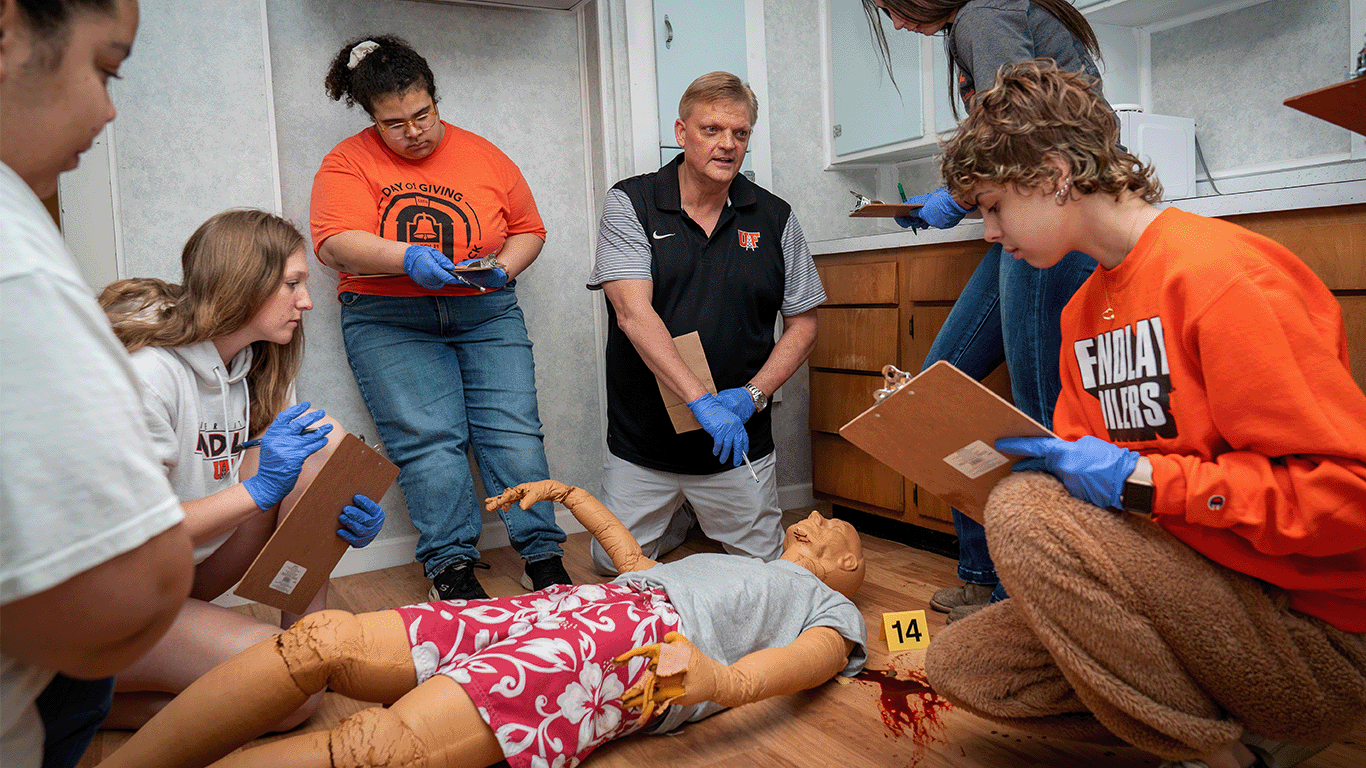
- Students gain hands on experience in processing crime scenes at the Behavioral & Justice Sciences’ dedicated crime scene house
- Students conduct evidentiary analysis in the Behavioral & Justice Sciences Department’s state-of-the-art forensic laboratory
- Students are grounded in criminological theory and engage in undergraduate research
- Students participate in hands-on self-defense training through the Self-Defense-Stress Management course
beyond graduation
Careers
Graduates of the White-Collar Crime and Fraud Investigation program are prepared for specialized roles that focus on financial crime detection, prevention, and enforcement across public and private sectors. These positions often involve analyzing complex data, investigating fraud schemes, and supporting legal proceedings.
- Forensic Accountant
- Certified Fraud Examiner
- Corporate Compliance Officer
- Financial Crime Analyst
- Cybercrime Investigator
- Insurance Fraud Investigator
- Healthcare Fraud Analyst
- Money Laundering Investigator
- Risk Assessment and Loss Prevention Specialists
- Federal Law Enforcement Agent (FBI, Secret Service, etc.)
- Financial Intelligence/Compliance Officer
Graduates may also pursue careers in government agencies, banking and finance, consulting firms, or continue their education in law school or advanced criminal justice or forensic programs.
TESTIMONIALS
The Oiler Experience
Hear directly from students about their experience
at the University of Findlay.

“The most enjoyable part of being a Criminal Justice major is how intensely caring the faculty is. Your professors remember you, your work, and your achievements. Once you initially experience that in class, you will quickly grow to realize how positively impactful that attention to care and detail is. I will be forever grateful for the professors in our department.”
financial aid
Cost of Education
Students can earn endowed scholarships in addition to their merit scholarships during their time at Findlay.
opportunities
Clubs and Activities
There are many opportunities outside of the classroom to get involved, including:
At the University of Findlay, there are many clubs and organizations offered on campus in which students participate. With nearly 80 unique student clubs including the Criminal Justice/ Forensic Science Club and Innocence Project Chapter, you are sure to find and make friends with peers who share your interests.
Examples of Criminal Justice/ Forensic Science Club and Innocence Project Chapter activities include:
- Ride-
- Active participation in real-life law enforcement scenarios through utilization of Firearm Training Simulators
- Stimulating conversations and networking with professionals and experts in the criminal justice profession
- Tours of male and female prisons and jails, bureaus of criminal investigation, and area crime labs
- Processing mock crime scenes
- Police Canine demonstrations
- Examination of criminal cases including cold case
Alpha Phi Sigma is a National Criminal Justice Honor Society founded in January 1942 at Washington State University. It is a platform for outstanding criminal justice students, faculty members, and criminal justice professionals to collaborate on the basis of common interest, understanding, helpfulness, and community betterment.
Membership in Alpha Phi Sigma requires students to have declared a major in criminal justice or related field and have completed three full time semesters or equivalent. Students must also attain a minimum GPA of 3.2 on a 4.0 scale in their cumulative criminal justice classes and rank in the top 30% of their class.
college of business and humanities
Accreditation
The University of Findlay’s Criminal Justice White Collar Crime and Fraud Investigation Program adheres to the rigorous curricular standards established by the American Academy of Criminal Justice Sciences (ACJS).
Accreditation status is reviewed on a regular basis. For the most current accreditation information, visit the University of Findlay Accreditation page.