
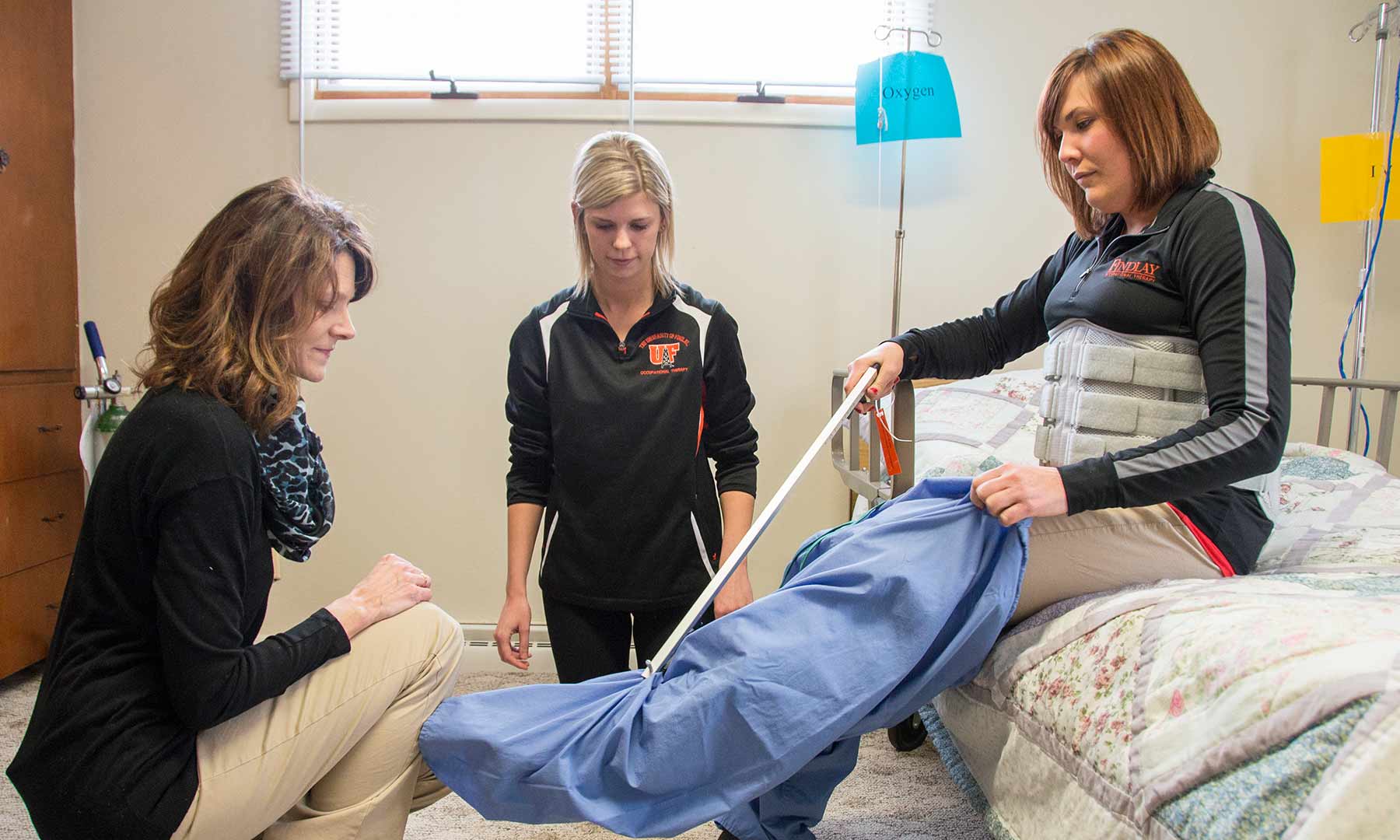
University Of Findlay Students

College of Health Professions

Fieldwork

Supervised fieldwork is an important component of the occupational therapy curriculum, and two levels of experience are required. 
 

Fieldwork Forms  

Student Evaluations 

Students are evaluated by the same evaluation form for the pediatric, adult, and community level I fieldwork experiences.  

Level I  

“Fieldwork education is a crucial part of professional preparation and is best integrated as a component of the curriculum design. The fieldwork experience is designed to promote clinical reasoning and reflective practice, transmit the values and beliefs that enable ethical practice, and develop professionalism and competence in career responsibilities. Fieldwork experiences should be implemented and evaluated for their effectiveness by the educational institution. The experience should provide the student with the opportunity to carry out professional responsibilities under the supervision of qualified personnel serving as a role model. The goal of Level I fieldwork is to introduce students to fieldwork, apply knowledge to practice, and develop understanding of the needs of clients.” (STANDARDS, ACOTE 2018) 

Level I Fieldwork experiences are devised to integrate a student’s basic academic knowledge with clinical practice through experiential learning in a context critical to later therapeutic application of that knowledge. Level I Fieldwork provides opportunities for the development of appropriate clinical skills, effective communication, and professional behaviors. 
 

Level II  

“The goal of Level II fieldwork is to develop competent, entry-level, generalist occupational therapists. Level II fieldwork must be integral to the program’s curriculum design and must include an in-depth experience in delivering occupational therapy services to clients, focusing on the application of purposeful and meaningful occupation and research, administration, and management of occupational therapy services. It is recommended that the student be exposed to a variety of clients across the lifespan and to a variety of settings.” (STANDARDS, ACOTE 2018)  

Level II Fieldwork experiences develop core competencies necessary for entry therapists. These competencies are in a variety of practice areas with clients of various ages and performance deficits. Students will experience supervised delivery of occupational therapy services.  
 

Answers to Your Fieldwork Questions 

This website will help provide answers about fieldwork questions such as: 

  • Supervision 
  • Grading 
  • Difficulties with supervisors 
  • Failing 
  • Unfair treatment 
  • Accommodations for a disability 

Course Descriptions: 

Doctor of Occupational Therapy Program 

OCTH 534 Level I Fieldwork A (Pediatrics) 

During this initial fieldwork experience students observe and participate in occupational therapy clinical practice settings that facilitate the integration of concurrent academic course work during the semester. These experiential learning opportunities enhance student professional development and prepare students for subsequent clinical and classroom learning opportunities. This course will be graded S/U. 

OCTH 626 Level I Fieldwork B (Adult) 

During this initial fieldwork experience students observe and participate in occupational therapy clinical practice settings that facilitate the integration of concurrent academic course work during the semester. These experiential learning opportunities enhance student professional development and prepare students for subsequent clinical and classroom learning opportunities. This course will be graded S/U. 
  

OCTH 702 Level I Fieldwork C (Community Based) 

This Level I fieldwork course provides students with an opportunity to observe and explore needs and services in a community setting. Students will identify the psychological and social factors influencing engagement in occupation for populations, groups and individuals. The community site utilized in this fieldwork placement serves as the basis for other coursework related to community program development and preparation for grant writing. This course will be graded S/U. 

OCTH 707 Level II Fieldwork A 

During this fieldwork students engage in clinical practice experiences in various practice settings that serve specific client populations that have occupational performance limitations. These experiences include opportunities to function in the occupational therapist role and demonstrate occupation-based practice skills. Students demonstrate the ability to apply professional ethics and use critical thinking, clinical reasoning and problem solving to guide decision making in an evidence-based manner throughout the entire occupational therapy process. This course will be graded S/U. 

  
OCTH 707 Level II Fieldwork B 

During this fieldwork students engage in clinical practice experiences in various practice settings that serve specific client populations that have occupational performance limitations. These experiences include opportunities to function in the occupational therapist role and demonstrate occupation-based practice skills. Students demonstrate the ability to apply professional ethics and use critical thinking, clinical reasoning and problem solving to guide decision making in an evidence-based manner throughout the entire occupational therapy process. This course will be graded S/U.   

Master of Occupational Therapy Program 

OCTH 513 Level I Fieldwork A 

During this Level I Fieldwork experience students observe and participate in learning opportunities at occupational therapy clinical practice settings that enable the integration of concurrent academic course work during the semester.  The student is exposed to a variety of opportunities to enhance professional development.  This course will be graded S/U. 
 
OCTH 514 Level I Fieldwork B 

During the second Level I Fieldwork experience students observe and participate in learning opportunities at occupational therapy clinical practice settings that enable the integration of concurrent academic course work during the semester. The student is exposed to a variety of opportunities to enhance professional development. This course will be graded S/U. 

OCTH 660 Level I Fieldwork C (Community-Based) 

During this Level I Fieldwork experience students observe and participate in learning opportunities at community practices that enable them to identify the contexts and psychological and social factors that influence engagement in occupations. Students are exposed to a variety of professional practice issues that provide an opportunity to emphasize professional development, particularly in the area or program development. Students observe and participate in a variety of assessments and intervention activities which integrate classroom knowledge. This course will be graded S/U. 

OCTH 690 Level II Fieldwork A 

During this internship students engage in clinical practice experiences in various settings that serve specific populations that have occupational performance limitations.  These experiences include opportunities to function as therapists who understand and embrace an occupation-based approach to practice.  Students demonstrate the ability to apply professional ethics and use critical thinking, clinical reasoning and problem solving to guide decision-making throughout the OT process.  This course will be graded S/U. 

OCTH 691 Level II Fieldwork B 

During this internship students engage in clinical practice experiences in various settings that serve specific populations that have occupational performance limitations.  These settings include opportunities to function as therapists who understand and embrace an occupation-based approach to practice.  Students demonstrate the ability to apply professional ethics and use critical thinking, clinical reasoning and problem solving to guide decision-making throughout the OT process.  This course will be graded S/U. 

Objectives: 

Doctor of Occupation al Therapy 

Objectives for OCTH 534 & 626 Level I Fieldwork (Pediatric and Adult) 

The student will: 

  1. Use professional terminology and respectful communication when interacting with professionals and clients in the practice setting. 
  1. Demonstrate clear, concise, grammatically correct style in all written assignments. 
  1. Identify frame of references used in the assigned practice setting. 
  1. Describe the characteristics of a frame of reference that would make it appropriate for use with a particular client. 
  1. Identify the screening and/or assessment tools used in the practice setting. 
  1. Observe situational variables that impact accurate assessment results in the practice setting. 
  1. Review environmental modifications and assistive technology used in the practice setting and/or by a specific client. 
  1. Explain occupational therapy practice to a client or professional in the assigned practice setting. 
  1. Determine the process used when referring clients to specialists in the community. 
  1. Follow universal precautions and infection control if asked to participate in clients’ treatment. 
  1. Critically analyze interactions between the occupational therapist, client, family members, and other professionals in the practice setting. 
  1. Determine the role of specialists in the practice setting. 
  1. Assess the therapist’s therapeutic use of self and grading of occupations, through observation during client treatment in the practice setting. 
  1. Examine the use of client/family education provided by the therapist in the practice setting. 
  1. Observe the teaching/learning techniques and strategies used by the occupational therapist when educating family members or other professionals. 
  1. Identify and describe the psychosocial factors that influence client engagement in occupations. 
  1. Evaluate the collaborative role between occupational therapists and occupational therapy assistants, if applicable. 
  1. Assess relationship of stated goals, interventions and outcomes, through observation and questions asked in the practice setting. 
  1. Determine the procedures and documentation used for termination of treatment in the practice setting. 
  1. Review the documentation methods and procedures used in the practice setting. 

Understanding that confirmation and acceptance of a student placement/rotation is an acknowledgement and agreement of established fieldwork objectives and the ability to support students during Level I and Level II fieldwork (ACOTE Standard C.1.3 & C.1.8). 

Objectives for OCTH 702 Level I Fieldwork (Community-Based) 

The student will: 

  1. Educate community-based professionals about the role of OT and the possible benefits OT services would provide the clients in their programs. 
  1. Identify the mission and philosophy of the community setting. 
  1. Describe the population and its needs that are served in the setting. 
  1. Identify the psychological and social factors that influence client engagement in occupations. 
  1. Identify the environment and contexts in which programming occurs and how they positively and/or negatively impact the client’s participation and engagement in programming. 
  1. Identify the client’s areas of occupations being addressed in current programming. 
  1. Assess the roles and responsibilities of service providers in the community setting. 
  1. Assess the professional licensure and/or training required by the service providers. 
  1. Appraise current trends and policies that influence the provision of health and human service in the setting. 
  1. Identify funding/reimbursement policies and sources. 
  1. Compare and contrast community service delivery models with traditional services (i.e. hospital, nursing facility). 
  1. Identify unmet needs and establish a plan of action to assist the site in investigating various methods to meet those needs. 

Understanding that confirmation and acceptance of a student placement/rotation is an acknowledgement and agreement of established fieldwork objectives and the ability to support students during Level I and Level II fieldwork (ACOTE Standard C.1.3 & C.1.8). 

Objectives for OCTH 707 & 708 Level II Fieldwork (Various settings) 

The student will: 
 

  1. Integrate the ability to identify and utilize effective written, oral and nonverbal communication methods with clients, their families and caregivers, colleagues, other professionals, and the public. 
  1. Integrate and employ logical thinking, critical analysis, problem solving, and creativity in the understanding and application of occupation in practice, leadership, and research of the profession. 
  1. Consider and incorporate the role of lifestyle choices and sociocultural, and socioeconomic factors in contemporary society as well as these influences on occupation within an ethical context during assessment, treatment design and implementation in the practice setting. 
  1. Evaluate and apply knowledge of the interaction of the person, environment, and occupation with the analysis of tasks relative to occupational performance, performance, components, and performance contexts. 
  1. Demonstrate the ability to explain the value of occupational therapy practice to clients, families, and other members of the health care team in the assigned practice setting. 
  1. Identify and describe the psychosocial factors that influence client engagement in occupations. 
  1. Choose appropriate theories and goals for intervention that address the need for balance among the areas of occupation, age-appropriate roles, life tasks, and developmental issues across the life span from a sociocultural perspective. 
  1. Compare and apply the knowledge of health and disability and the effect of such conditions to promote health maintenance and safety programs that are age and socioculturally appropriate to occupational performance. 
  1. Select and use appropriate standardized and non-standardized screening, assessment, and evaluation tools, and methods based on the needs of the client, contextual factors, and psychometric properties to determine the need for occupational therapy services. 
  1. Design, in cooperation with the occupational therapy assistant, a procedure for the collection of screening and evaluation data. 
  1. Interpret evaluation data following test procedures and protocols with consideration of factors that might bias the results such as culture, disability status, and situational variables. 
  1. Select, in collaboration with clients/family/significant others, colleagues, and other professionals, a theoretical base and model of practice as the basis for an occupationally based intervention plan that is consistent with the client’s goals, performance area strengths, deficits, and environmental context. 
  1. Choose and implement appropriate safety, infection control, and universal precaution protocols to ensure the safety and well-being of clients during screening, evaluation, and therapeutic intervention. 
  1. Determine when it is necessary and make appropriate referrals to specialists, both internal and external to the profession, for evaluation, consultation and/or intervention. 
  1. Follow procedures for documentation of occupational therapy services to ensure accountability of service provision that meets standards of reimbursement and communicates the need and rationale for occupational therapy services appropriate to the system in which services are delivered. 
  1. Design and employ a therapeutic intervention plan utilizing therapeutic use of self in dyadic and group interventions, demonstrating the ability to grade and adapt occupational tasks appropriate to the needs and abilities of the client. 
  1. Assess and implement appropriate home and community programming to support occupational performance in the client’s natural environment, educating and training the client/family/significant others/caregivers to facilitate skills in promoting health and safety. 
  1. Select basic learning theories and principles of the teaching/learning process when educating clients/family/caregivers, the public, third party payers, and other professionals about the role of therapeutic occupation in health and disability and its value to the client. 
  1. Choose and implement compensatory strategies and/or adapt the environment through family/caregiver training regarding technology, adaptations to the environment and involvement of humans and non-humans in the completion of occupations. 
  1. Develop treatment plans, in collaboration with the occupational therapy assistant, and supervise the provision of therapeutic interventions. 
  1. Compare evaluation and intervention data with stated goals and anticipated outcomes to determine the need for intervention plan modification or termination as well as the efficacy of the occupational therapy intervention. 
  1. Plan for and terminate the intervention plan to include a summary of outcomes, recommendations, and referrals after a discussion of post discharge needs with the client/family/significant other/caregiver, colleagues, and other professionals. 
  1. Assess the current trends and policies in health care, education, community, and social systems and their influence on occupational therapy practice. 
  1. Assess the role and responsibility of the practitioner to address changes in service delivery policies and to effect changes in the system. 
  1. Examine the implications and effects of federal and state regulatory and legislative agencies on government regulations, policies, and statutes that impact the provision of occupational therapy services. 
  1. Appraise applicable national and state regulations for credentialing. 
  1. Develop a knowledge base and act in accordance with federal, state, third party, and private payer reimbursement policies and procedures including maintenance of billing and payment records. 
  1. Construct fundamental marketing skills to advance the profession and respond to the changing marketplace. 
  1. Integrate management and leadership concepts that include team collaboration and supervisory skills for the most effective use of occupational therapy and non-occupational therapy personnel time and skills. 
  1. Plan, develop, select, organize and maintain the staff, space, equipment, and supplies necessary to deliver services that meet programmatic needs. 
  1. Evaluate the efficacy of and need for service delivery through the documentation and analysis of program services and quality of care. 
  1. Demonstrate an awareness of the importance of professional responsibility in regard to the provision of fieldwork education and supervision. 
  1. Judge the importance of research and scholarly activities to the development of a body of knowledge relevant to professional practice and viability through exploration of research opportunities or research being conducted at the clinical site. 

Understanding that confirmation and acceptance of a student placement/rotation is an acknowledgement and agreement of established fieldwork objectives and the ability to support students during Level I and Level II fieldwork (ACOTE Standard C.1.3 & C.1.8). 

Master Occupational Therapy 

Objectives for OCTH 513 & 514 Level I Fieldworks (Pediatric & Adult) 

The student will: 

  1. Use professional terminology and respectful communication when interacting with professionals and clients in the practice setting. 
  1. Demonstrate clear, concise, and grammatically correct style in all written assignments. 
  1. Identify frame of references used in the assigned practice setting. 
  1. Describe the characteristics of a frame of reference that would make it appropriate for use with a particular client. 
  1. Identify the screening and/or assessment tools used in the practice setting. 
  1. Observe situational variables that impact accurate assessment results in the practice setting. 
  1. Review environmental modifications and assistive technology used in the practice setting and/or by a specific client. 
  1. Explain occupational therapy practice to a client or professional in the assigned practice setting. 
  1. Determine the process used when referring clients to specialists in the community. 
  1. Follow universal precautions and infection control if asked to participate in clients’ treatment. 
  1. Critically analyze interactions between the occupational therapist, client, family members, and other professionals in the practice setting. 
  1. Determine the role of specialists in the practice setting. 
  1. Assess the therapist’s therapeutic use of self and grading of occupations, through observation during client treatment in the practice setting. 
  1. Examine the use of client/family education provided by the therapist in the practice setting. 
  1. Observe the teaching/learning techniques and strategies used by the occupational therapist when educating family members or other professionals. 
  1. Identify and describe the psychosocial factors that influence client’s engagement in occupation. 
  1. Evaluate the collaborative role between occupational therapists and occupational therapy assistants, if applicable. 
  1. Assess relationship of stated goals, interventions and outcomes, through observation and questions asked in the practice setting. 
  1. Determine the procedures and documentation used for termination of treatment in the practice setting. 
  1. Review the documentation methods and procedures used in the practice setting. 

Understanding that confirmation and acceptance of a student placement/rotation is an acknowledgement and agreement of established fieldwork objectives and the ability to support students during Level I and Level II fieldwork (ACOTE Standard C.1.3 & C.1.8). 

OCTH 660 Level I Fieldwork C (Community-Based) 

The student will: 

  1. Educate community-based professionals about the role of OT and the possible benefits OT services would provide clients in their programs. 
  1. Identify the mission and philosophy of the community setting. 
  1. Describe the population and its needs that are served in the setting. 
  1. Identify the psychological and social factors that influence the client’s engagement in their occupations. 
  1. Identify the environment and contexts in which programming occurs and how they positively and/or negatively impact the client’s participation and engagement in programming. 
  1. Identify the client’s areas of occupation being addressed in current progamming. 
  1. Assess the roles and responsibilities of service providers in the community setting. 
  1. Assess the professional licensure and/or training required by the service providers. 
  1. Appraise current trends and policies that influence the provision of health and human service in the community setting. 
  1. Identify funding/reimbursement policies and sources. 
  1. Compare and contrast community service delivery models with traditional services (i.e. hospital, nursing facility). 
  1. Identify unmet needs and establish a plan of action to assist the site in investigating various methods to meet those needs. 

Understanding that confirmation and acceptance of a student placement/rotation is an acknowledgement and agreement of established fieldwork objectives and the ability to support students during Level I and Level II fieldwork (ACOTE Standard C.1.3 & C.1.8). 

OCTH 690 & 691 Level II Fieldwork 

The student will: 

  1. Integrate the ability to identify and utilize effective written, oral and nonverbal communication methods with clients, their families and caregivers, colleagues, other professionals, and the public. 
  1. Integrate and employ logical thinking, critical analysis, problem solving, and creativity in the understanding and application of occupation in practice, leadership, and research of the profession. 
  1. Consider and incorporate the role of lifestyle choices and sociocultural and socioeconomic factors in contemporary society as well as these influences on occupation within an ethical context during assessment, treatment design and implementation in the practice setting. 
  1. Evaluate and apply knowledge of the interaction of the person, environment, and occupation with the analysis of tasks relative to occupational performance, performance, components, and performance contexts. 
  1. Demonstrate the ability to explain the value of occupational therapy practice to client’s, families, and other members of the health care team in the assigned practice setting. 
  1. Choose appropriate theories and goals for intervention that address the need for balance among the areas of occupation, age-appropriate roles, life tasks, and developmental issues across the life span from a sociocultural perspective. 
  1. Compare and apply the knowledge of health and disability and the effect of such conditions to promote health maintenance and safety programs that are age and socioculturally appropriate to occupational performance. 
  1. Select and use appropriate standardized and non-standardized screening, assessment, and evaluation tools, and methods based on the needs of the client, contextual factors, and psychometric properties to determine the need for occupational therapy services. 
  1. Design, in cooperation with the occupational therapy assistant, a procedure for the collection of screening and evaluation data. 
  1. Identify how psychosocial factors are influencing the client’s engagement in occupation and discuss how that knowledge was integrated into meaningful, client-centered, occupation-based care. 
  1. Interpret evaluation data following test procedures and protocols with consideration of factors that might bias the results such as culture, disability status, and situational variables. 
  1. Select, in collaboration with clients/family/significant others, colleagues, and other professionals, a theoretical base and model of practice as the basis for an occupationally based intervention plan that is consistent with the client’s goals, performance area strengths, deficits, and environmental context. 
  1. Choose and implement appropriate safety, infection control, and universal precaution protocols to ensure the safety and well-being of clients during screening, evaluation, and therapeutic intervention. 
  1. Determine when it is necessary and make appropriate referrals to specialists, both internal and external to the profession, for evaluation, consultation and/or intervention. 
  1. Follow procedures for documentation of occupational therapy services to ensure accountability of service provision that meets standards of reimbursement and communicates the need and rationale for occupational therapy services appropriate to the system in which services are delivered. 
  1. Design and employ a therapeutic intervention plan utilizing therapeutic use of self in dyadic and group interventions, demonstrating the ability to grade and adapt occupational tasks appropriate to the needs and abilities of the client. 
  1. Assess and implement appropriate home and community programming to support occupational performance in the client’s natural environment, educating and training the client/family/significant others/caregivers to facilitate skills in promoting health and safety. 
  1. Select basic learning theories and principles of the teaching/learning process when educating clients/family/caregivers, the public, third party payers, and other professionals about the role of therapeutic occupation in health and disability and its value to the client. 
  1. Choose and implement compensatory strategies and/or adapt to the environment through family/caregiver training regarding technology, adaptations to the environment and involvement of humans and non-humans in the completion of occupations. 
  1. Develop treatment plans, in collaboration with the occupational therapy assistant, and supervise the provision of therapeutic interventions. 
  1. Compare evaluation and intervention data with stated goals and anticipated outcomes to determine the need for intervention plan modification or termination as well as the efficacy of the occupational therapy intervention. 
  1. Plan for and terminate the intervention plan to include a summary of outcomes, recommendations, and referrals after a discussion of post discharge needs with the client/family/significant other/caregiver, colleagues, and other professionals. 
  1. Assess the current trends and policies in health care, education, community, and social systems and their influence on occupational therapy practice. 
  1. Assess the role and responsibility of the practitioner to address changes in service delivery policies and to effect changes in the system. 
  1. Examine the implications and effects of federal and state regulatory and legislative agencies on government regulations, policies, and statutes that impact the provision of occupational therapy services. 
  1. Appraise applicable national and state regulations for credentialing. 
  1. Develop a knowledge base and act in accordance with federal, state, third party, and private payer reimbursement policies and procedures including maintenance of billing and payment records. 
  1. Construct fundamental marketing skills to advance the profession and respond to the changing marketplace. 
  1. Integrate management and leadership concepts that include team collaboration and supervisory skills for the most effective use of occupational therapy and non-occupational therapy personnel time and skills. 
  1. Plan, develop, select, organize and maintain the staff, space, equipment, and supplies necessary to deliver services that meet programmatic needs. 
  1. Evaluate the efficacy of and need for service delivery through the documentation and analysis of program services and quality of care. 
  1. Demonstrate an awareness of the importance of professional responsibility in regard to the provision of fieldwork education and supervision. 
  1. Judge the importance of research and scholarly activities to the development of a body of knowledge relevant to professional practice and viability through exploration of research opportunities or research being conducted at the clinical site. 

Understanding that confirmation and acceptance of a student placement/rotation is an acknowledgement and agreement of established fieldwork objectives and the ability to support students during Level I and Level II fieldwork (ACOTE Standard C.1.3 & C.1.8).