college of Health Professions
Diagnostic Medical Sonography
Use ultrasound technology to help healthcare teams understand what is happening inside the body. Build scanning and patient care skills through laboratory training and supervised clinical experiences.
Overview
About the Program
University of Findlay’s Diagnostic Medical Sonography program prepares students to become highly skilled, patient-centered ultrasound professionals through a rigorous, full-time educational experience that combines advanced academics, hands-on laboratory training, and immersive clinical education.
Designed to meet the evolving demands of modern healthcare, the program emphasizes diagnostic imaging, critical thinking, professionalism, and clinical competency across abdominal, obstetrical/gynecological, and related sonographic specialties. Students complete comprehensive didactic coursework, specialty-focused sonography education, and extensive supervised clinical experience to ensure graduates are workforce-ready and prepared for professional credentialing.
Please note: The Diagnostic Medical Sonography program begins in the summer semester only.
Program
Highlights
Complete in Approximately 14 Months
Small-Group Laboratory Instruction
Credentialing Preparation, Clinical Competency, and Employer Readiness
6:1 Student-to-Instructor Ratio for Individualized Scanning Development
Cadaver Laboratory Experience
College of health professions
At a Glance
College
College of Health Professions
Degree
Bachelor of Science in Diagnostic Medical Sonography
Format
On-Campus
Required credits
120+ Credits
Curriculum
Course Requirements
In conjunction with the Diagnostic Medical Sonography – General program, we offer a certificate, associate degree, and bachelor’s degree. To view all course information and curriculum for each offering in our online catalog, please visit the links below.
The curriculum consists of required courses grounded in sonographic physics and instrumentation, cross-sectional anatomy, pathology, patient care, and specialty-specific diagnostic imaging. Students complete comprehensive didactic, laboratory, and clinical coursework designed to develop technical proficiency, critical thinking, and professional readiness.
apply
Admissions Requirements
Admission to the University of Findlay Diagnostic Medical Sonography program is competitive and based on academic performance, completion of prerequisite requirements, and availability of clinical placements. Students are admitted once per year with a summer semester start.
Admission Process – Due January 1st; Summer Start Only
In their junior year of study, University of Findlay students currently enrolled in the Sonography programs majors will automatically be considered for admission to the upcoming cohort upon submission of:
- Apply to the program & pay the application fee, https://apply.findlay.edu/register/Sonography
- Patient Confidentiality Agreement*
- Two (2) Observation Form* (4 hours in General and 4 hours in Echo)
- All current post-secondary transcripts
Please send 2 & 3 as one submission via email to dms@findlay.edu. In your message, state which class and specialty you are interested in. (e.g., “Summer 2026 – General Sonography”, or “Summer 2026 – Echocardiography”)
Prerequisites and degree must be obtained prior to starting the program
- Apply to the University, https://apply.findlay.edu/portal/apply-now
- Select the intended entry term
- The program is a summer start only. For Summer 2026, you will choose the 25-26 academic year
- Submit all Official Transcripts from any institution you have attended
- Transcripts may be sent electronically directly from the institutions to admissions@findlay.edu
- Submit a non-refundable $50 application fee, which may be paid electronically on the application portal
- Submit the following documents via email to dms@findlay.edu. In your message, state which class and specialty you are interested in. (e.g., “Summer 2026 – General Sonography”, or “Summer 2026 – Echocardiography”)
- Patient Confidentiality Agreement*
- Two (2) Observation Forms* (4 hours in General and 4 hours in Echo)
- First- Time Freshmen & Degree-Seeking Transfer Students
High school students interested in Diagnostic Medical Sonography will not need to submit the above documents until their junior year of study. High school and transfer students will want to ensure they complete the following to begin their academic journey:
- Apply to the University
- Submit your Official High School Transcript
- Transcripts may be sent electronically directly from the high school to admissions@findlay.edu
- Connect with your Admissions Counselor to ensure your application is complete
All dates are approximate. Please contact the Sonography programs at dms@findlay.edu with any specific questions.
January 1 – Application file must be complete and include the following:
- Patient Confidentiality Agreement
- Observation Form x2 (Four hours each in Echo and General)
- All current post-secondary (College) transcripts
- Minimum cumulative GPA of 2.5 on a 4.0 scale
- Completion of all prerequisites with a “C” or higher
- UF acceptance
The following criteria define the technical standards applicants are generally expected to meet to participate and function in the laboratory, classroom and clinical setting. These technical standards are necessary and essential to provide for the health and safety of students and of the patients receiving care.
All students in the Diagnostic Medical Sonography Programs must possess the intellectual ability to learn, integrate, analyze, and synthesize data. Students must have functional use of the senses of vision and hearing and motor function capabilities to meet the demands of the profession.
Students must:
- Observe patients, manipulate equipment, and evaluate image quality.
- Observe changes in patient condition
- Utilizing equipment for maximum diagnostic results to include computers
- Differentiate primary colors, shades of gray, and real-time images, as well as delineate spatial relationships, borders, visual comparisons and pathological entities in two and three-dimensional planes
- Demonstrate sufficient hearing to access patient needs and communicate verbally with other health care providers.
- Acquire information
- Perceive nonverbal communication
- Differentiate Doppler signals
- Hear audible alarms
- Demonstrate sufficient verbal and written skills to communicate needs promptly and efficiently in English.
- Must verbally instruct patients
- Speak in a way that is clearly understood by the average person at close range
- Foster mature, sensitive, and effective relationships with patients, colleagues and other health care professionals
- Demonstrate patient confidentiality and medical ethics
- Demonstrate sufficient gross and fine motor coordination to respond promptly and ensure patient safety.
- Safely perform imaging procedures
- Assess and comprehend the condition of the patient
- Ability to lift 50 pounds
- Ability to stand and walk up to 8 hours a day
- Ability to exercise a full range of body motions with intermittent lifting, bending, squatting, kneeling and twisting
- Demonstrate satisfactory intellectual and emotional functions to exercise independent judgment and discretion in the safe technical performance of sonographic imaging procedures.
- Function effectively under stress
- Adapt to changing environments and exhibit independent judgment and critical thinking
- Demonstrate professionalism, compassion, altruism, empathy, integrity, concern for others, interest, and motivation
- Intellectual and Communication Skills
- Ability to work in a noisy environment with many interruptions
- Ability to explain procedures and patient preparations clearly, verbally or written
- Ability to apply critical thinking skills when obtaining a clinical history from the patient and correlating that information with exam findings accurately
- Demonstrate respect for a diverse patient population
- Maintain CPR certification
opportunities
Hands-On Experience
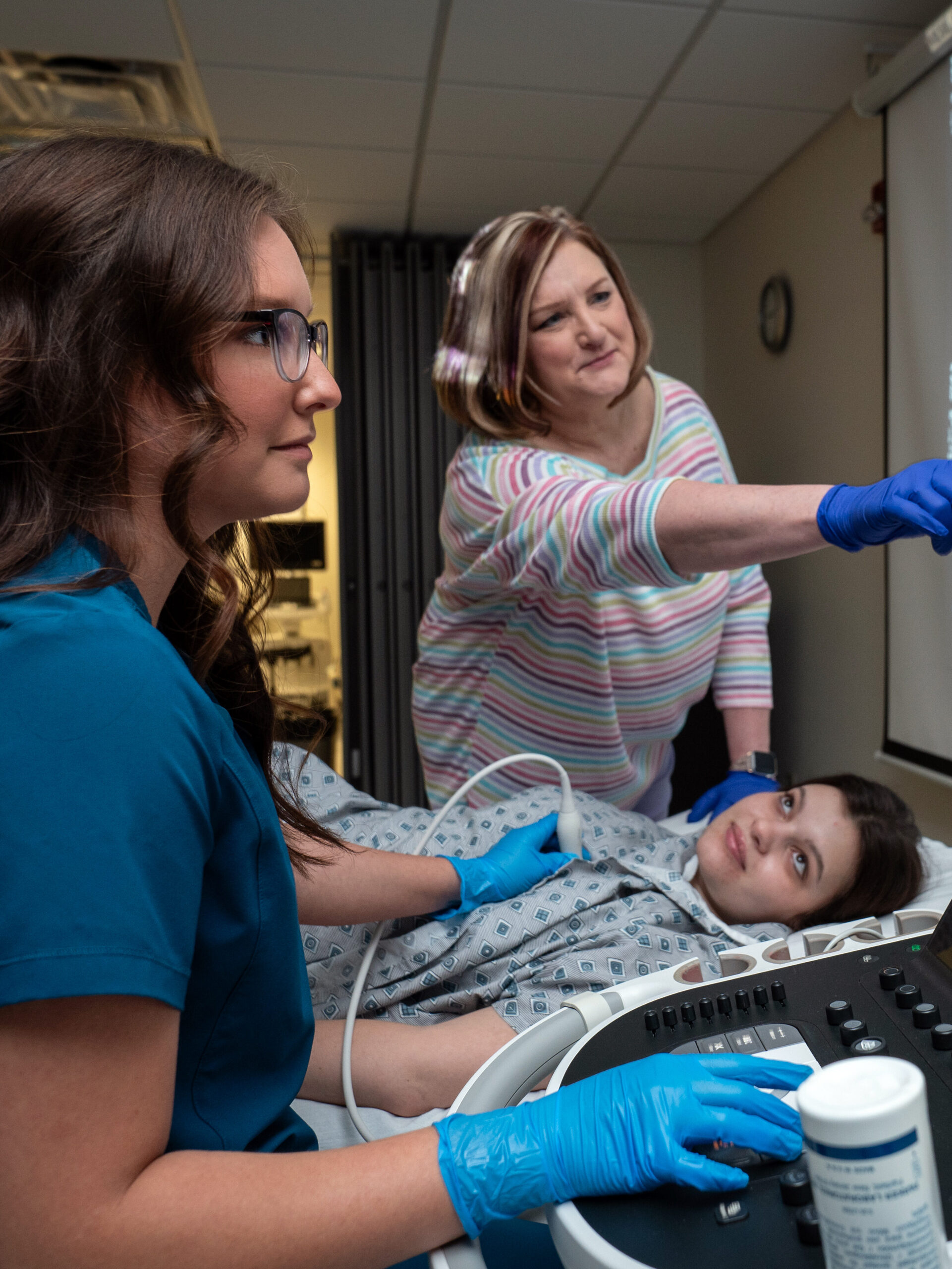
Students in the University of Findlay Diagnostic Medical Sonography program complete approximately 35 weeks of supervised clinical education totaling around 1,400 hours, providing extensive real-world experience in patient care, diagnostic imaging, and professional practice.
Clinical education is designed to develop technical proficiency, clinical judgment, and workforce readiness through immersive, full-time placements in approved healthcare environments.
- Supervised abdominal, obstetrical/gynecological, and specialty sonographic imaging procedures
- Progressive scanning skill development with credentialed professionals
- Exposure to diverse patient populations and pathology
- Real-world patient care and interdisciplinary healthcare collaboration
- Preparation for credentialing examinations and entry-level employment
Primary clinical placements predominantly occur in hospital-based settings to maximize exposure to high-acuity care, diverse pathology, and comprehensive diagnostic experiences. Additional rotations may occur in outpatient or specialty settings when available to broaden clinical competency.
Prior to admission, applicants are required to complete 8 hours of professional observation (4 General Sonography and 4 Echocardiography), allowing prospective students to gain meaningful exposure to the profession and better understand program expectations.
This structured clinical model ensures graduates are prepared for the demands of modern sonographic practice while fostering confidence, competence, and employer readiness.
TESTIMONIALS
The Oiler Experience
Hear from those who found their place here.

“The University of Findlay sonography program not only taught me the skills and knowledge I needed to be a good sonographer but equipped me with the experience to become a compassionate and caring healthcare professional.”

“The University of Findlay’s Sonography program prepared me for my career by providing a unique program structure that focused on students’ understanding of classwork materials first and then diving into 9 months of immersive clinical experience.”

“I cannot explain how grateful I am that I attended the University of Findlay’s diagnostic medical sonography program. This program excels at not only preparing you to be a diagnostic medical sonographer but also supports you the entire way.”
financial aid
Cost of Education
Students can earn endowed scholarships in addition to their merit scholarships during their time at Findlay.
opportunities
Clubs and Activities
There are many opportunities outside of the classroom to get involved, including:
The Ohio Mu Iota Chapter of Lambda Nu is the national honor society for the radiologic and imaging sciences and is established within the College of Health Professions at the University of Findlay.
Lambda Nu recognizes academic excellence, professional commitment, leadership, and service within the imaging sciences while promoting scholarship and lifelong professional development.
Membership Opportunities
Membership is available for:
- Students
- Faculty
- Alumni
- Eligible students may apply after demonstrating strong academic performance, professional engagement, and commitment to the imaging sciences profession.
Benefits of Membership
Participation in Lambda Nu supports:
- Academic recognition
- Professional development
- Leadership opportunities
- Scholarship and research engagement
- Networking within the imaging sciences profession
Students interested in membership opportunities or eligibility requirements are encouraged to contact the program directly at NMI@findlay.edu.
Sonography students at the University of Findlay can get involved in the Sonography Student Organization — a student-run group that fosters professional growth, builds peer connections, serves the community, and champions the sonography profession.
Through involvement in the organization, students may participate in:
- Peer mentorship and professional networking
- Community service initiatives
- Sonography awareness and outreach events
- Program open houses and prospective student engagement
- Professional development opportunities
The organization provides students with additional opportunities to strengthen leadership skills, connect with peers across sonography specialties, and promote the profession within the community
college of Health Professions
Accreditation
The University of Findlay Sonography Programs are accredited by the Commission on Accreditation of Allied Health Education Programs (CAAHEP) upon recommendation of the Joint Review Committee on Education in Diagnostic Medical Sonography (JRC-DMS).